AI Institute Summer Camp ‘26
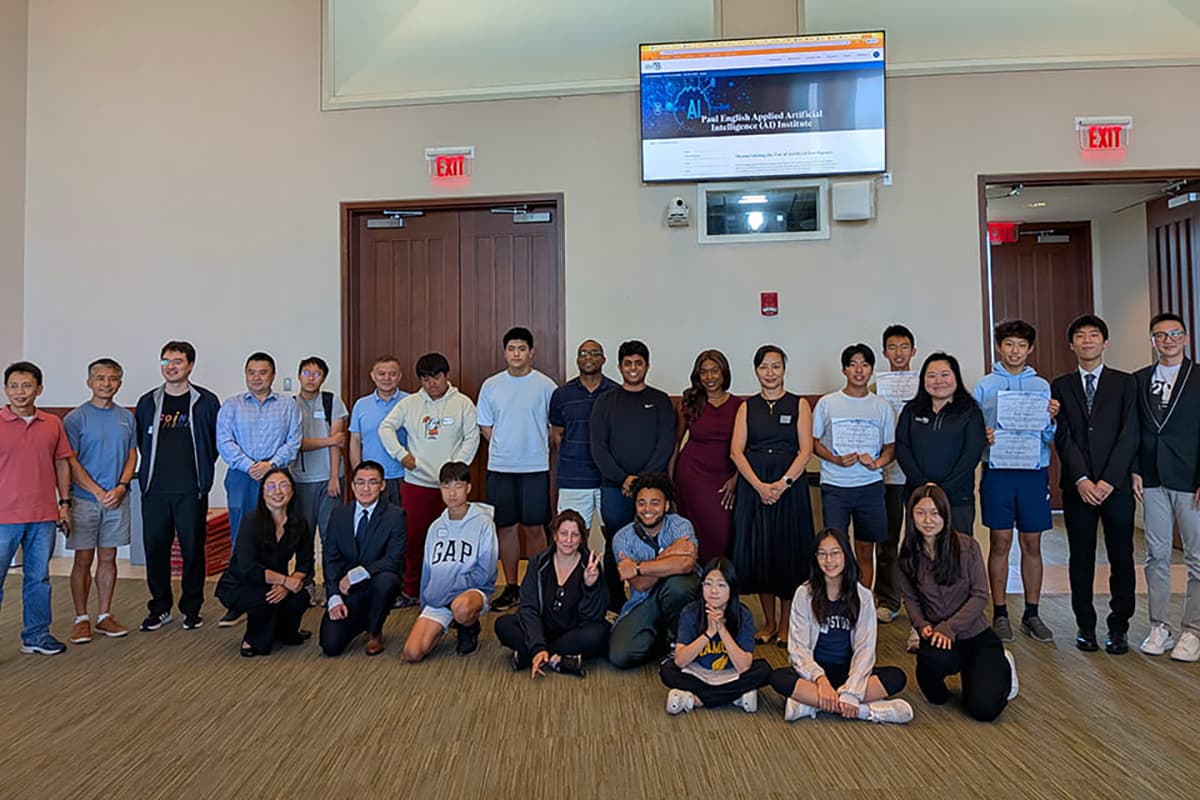
The Paul English Applied Artificial Intelligence Institute (PEAAII) at the University of Massachusetts Boston is launching its AI Summer Camp from July 27 to August 28, 2026, a five-week, project-based program where students of all backgrounds build skills in areas like machine learning, computer vision, natural language processing, generative AI, robotics, and AI ethics. Through a hybrid format and faculty mentorship, students progress from foundational concepts to hands-on, portfolio-ready projects in a real research environment. The program concludes with the final day “AI in ONE Day” event on August 28th, where students present their work, with no prior programming experience required
Rolling Registration: Registration will be handled on a first-come, first-served basis, with a maximum of 20 spots available per week.
Program Details
The program follows a hybrid schedule with in-person sessions on Monday and Friday at the University of Massachusetts Boston, where lunch is provided, and virtual sessions on Tuesday through Thursday.
Week 1 - Introduction to AI & Machine Learning
Students will start their journey by understanding the foundations of how computers learn from data. They will go from a "curious beginner" to a "confident AI builder" in just five days.
- Key Takeaways: Learning how to train an AI model and improve it through simple experiments.
- Cool Projects: Building a personal image classifier and working with the same "AI coding assistants" used by engineers at Google and Microsoft.
- College Prep: Students demonstrate initiative by solving an original problem, which makes for a compelling personal narrative in application.
- (See attached syllabus)
Week 2 - From Neural Networks to Intelligent Machines
This week brings code to life. Students will learn how AI allows robots to "see" and interact with the physical world using specialized hardware.
- Key Takeaways: Understanding how neural networks recognize patterns and how to run AI on small, portable computers like the Raspberry Pi.
- Cool Projects: Using a robotic arm to pick up objects and creating a custom system that can detect things through a camera in real-time.
- College Prep: Hands-on experience with hardware integration and professional equipment like robotic arms and GPU servers.
- (See attached syllabus)
Week 3 - Speech and Natural Language Processing
We pull back the curtain on how tools like ChatGPT work. Students discover that these complex systems are "prediction machines," not magic.
- Key Takeaways: Understanding how computers process human language and the ethics behind "deepfakes" and voice cloning.
- Cool Projects: Creating a "Mood Detector" and testing whether people can tell the difference between student-written essays and AI-summarized text.
- College Prep: Developing critical thinking skills about technology's impact on society and learning the technical pipeline behind voice-activated tools.
- (See attached syllabus)
Week 4 - Generative AI & Creativity
This week explores the "creative power" of AI. Students learn to use AI for generating text, images, and audio while thinking like investigators.
- Key Takeaways: Mastering "prompt design" (the art of talking to AI) and investigating why AI sometimes makes mistakes (hallucinations).
- Cool Projects: Creating a multimedia production, like a narrated story or a podcast introduction, using a mix of AI tools.
- College Prep: Students have the opportunity to turn their creative projects into professional research posters or papers.
- (See attached syllabus)
Week 5: From Curiosity to Creation: Build Your First AI Project & Research Portfolio
The final week is about "From Curiosity to Creation." Students focus on high-level research and preparing their work for the world.
- Key Takeaways: Learning how to ask "meaningful questions" and seeing how AI models make decisions behind the scenes.
- Cool Projects: Conducting tests for machine "self-awareness" and creating a professional, portfolio-ready project to show off.
- College Prep: Students produce a formal "research-style write-up" perfect for college essays or major research competitions like ISEF.
- (See attached syllabus)
AI in One Day
The one-day event is about "Immersive AI in a Single Day." Students step into the world of artificial intelligence through a project-based experience that connects them to the broader AI Summer Research Camp community.
- Key Takeaways: A clear picture of what AI is, how it's used in the real world across areas like machine learning, computer vision, and natural language processing and what learning AI actually looks like in practice.
- Cool Projects: Building and presenting a mini AI project individually or in small teams applying what they've learned to create simple AI-driven solutions in just one day.
- Skills Gained: Problem-solving, critical thinking, and collaboration: applied through hands-on activities and guided instruction from experienced mentors.
Special Perk: Participants attend the AI Summer Research Camp's final showcase, watching real student projects and getting a firsthand look at what deeper engagement with AI can produce.
Student Outcomes
- AI Foundations: Develop a strong understanding of how AI models are built, trained, and evaluated across areas such as machine learning, computer vision, and language processing. Apply these concepts through hands-on experimentation and problem-solving.
- Portfolio Projects: Complete an end-to-end AI project that demonstrates technical skills, creativity, and real-world application. Build a portfolio piece suitable for academic programs, competitions, or future opportunities.
- Presentation and Leadership: Present projects clearly and confidently while leading discussions and collaborative work. Strengthen communication, critical thinking, and the ability to apply AI responsibly in real-world settings.
Tuition
- All 5 weeks: $4,495 (Recommended)
- Any 4 weeks: $3,596
- Any 3 weeks: $2,697
- Any 2 weeks, $1,798
- Any 1 week: $899
- AI in One Day - $399
How to Register
To successfully complete your registration, please follow the steps below:
- Students or parents access the Registration Form
- Complete all required information and submit any necessary materials
- Proceed to the payment section within the same form to complete payment
- Upload the payment receipt within the form
- Submit the form to finalize registration
- If space becomes unavailable for a selected week, the program team will follow up directly with the family regarding next steps.
Registration will be handled on a first-come, first-served basis, with a maximum of 20 spots available per week.
FAQ
- What’s the top idea and mindset you like for your children have when the camp done?
The top mindset we want students to have is curiosity, critical thinking, and the confidence to solve real-world problems.
AI is not just about programming; it is also about problem-solving. Students will learn how to define a problem, figure out the best way to provide a solution, and identify the best AI tools to address those problems efficiently.
- How will this program prepare students for the future?
Our summer camp gives students a unique opportunity to cope with the new AI revolution. The world is very different now, and AI is changing very fast. The summer camp trains students not only to use AI tools, but also to think about how to address real-world problems. If students only know how to do coding, that is not enough. The camp provides training on how to solve problems, how to build real-world applications, and how to present their ideas.
Students can complete portfolio-ready end-to-end projects, and they can use the summer camp outcome for other research competitions, college applications, or future research pathways.
- How do students with no coding experience succeed in the camp?
We understand that students come with different levels of technical skills. Some students may already know Python, and some may have zero coding background. That is okay.
Each day, professors provide lectures in the morning, PhD students lead live sessions in the afternoon, and assistants provide guided practice and personal help. We will also share some materials before the summer camp starts, so students can review the basic principles of coding.
The more important part for our summer camp is whether the student is curious, willing to learn, and willing to solve problems.
- What can a 9th grader learn in one or two weeks? What kind of projects would you offer?
Each week is independent, so students can join one week or stack any week in any order they like. Even in one or two weeks, students can learn key AI foundations and build hands-on projects.
For example, students can build their first machine learning model, work on computer vision and object detection, build an AI chatbot, create generative AI projects with text, images, audio, and video, or present a poster or report.
The goal is that students do not just learn concepts. They work directly with AI tools, design inputs, compare outputs, build projects, and present what they created with their teams.
- Do you have any standout projects or success stories?
We also want to share one example from last summer. During one lab session, we saw three boys playing games together. At first, we were upset. But our TAs were very patient. They talked with the boys to see what their interests were and encouraged them to focus on expanding them.
On the last day, those three boys built a computer game to explain why it is important to protect the environment and protect the Earth. They connected their personal interest in games with AI, education, and a real-world problem. This shows why personal guidance and multi-level mentorship are so important.
- Why is this year’s camp stronger?
We decided to make the summer camp a university-level AI training experience. Every day, the professor will provide a 3-hour lecture on fundamental theories, methods, and real-world cases. The PhD student will lead a 3-hour live session in the afternoon, and the assistants will provide two hours of guided practice at different levels of mentorship.
We target to help students build real-world applications and complete portfolio-ready end-to-end projects. Students can use the summer camp outcome for research competitions, college applications, academic programs, or publication pathways. For competent students, PhD advisors are eager to help them learn how to do research, how to do critical thinking, and how to pursue future opportunities.
AI Institute Summer Camp Team
• Dr. Wei Ding, IEEE Fellow, Executive Director of the Paul English Applied Artificial Intelligence Institute and Professor of Computer Science at UMass Boston
• Dr. Ping Chen, Full Professor of Computer Engineering and Director of the Artificial Intelligence Lab at UMass Boston
• Dr. Xiaohui Liang, IEEE Fellow, Associate Chair of the Computer Science Department, Associate Professor of Computer Science at UMass Boston, leads the Mobile Computing and Privacy Lab
• Dr. Shichao Pei, Assistant Professor in Computer Science at UMass Boston, whose research interests include machine learning, foundation models, and AI safety
• Dr. Bo Sheng, Professor of Computer Science at UMass Boston, whose research includes edge computing, mobile systems, cloud computing, robotics, and cybersecurity
• Dr. Yinxin Wan, Assistant Professor in Computer Science at UMass Boston, whose interests include secure and trustworthy AI, IoT, and networked systems
• Chengjie Zheng, PhD Candidate of Computer Science, PEAAII Assistant, Core Member of Student Advisory Council
• Ajanee Igharo, MBA Candidate and BA in Psychology, PEAAII Assistant, Core Member of Student Advisory Council
• Dora (Dawn) Nguyen, Undergraduate in Accounting, Minor in Psychology, PEAAII Assistant, Core Member of Student Advisory Council
• Rebaz Kamal, Undergraduate in Computer Engineering, Minor in Computer Science, PEAAII Assistant, Core Member of Student Advisory Council
• Rami Huu Nguyen, PhD Student in Computational Science, Data Analytics, PEAAII Assistant, Core Member of Student Advisory Council
• Justin Wang, incoming senior at Lexington High School, a returning Paul English Applied AI Institute Summer Camp TA
• Jasmine Gu, incoming freshman at UC Berkeley, a returning Paul English Applied AI Institute Summer Camp TA
Have any additional questions?
Register for the AI Institute Webinar on May 2nd